The stories that have moved me the most are about these young people who belonged to different organizations, she in the Revolutionary Workers' Party, he in the Secondary Students' Union. They met in the dry arm of Saladillo, were kidnapped, and before being killed, she asked him to sing a love song of farewell, and he sang the national anthem.
This began to pave the way for the exporting companies. Perhaps for this reason, they were one of the favorite targets of the criminal aggression of the Marxist hordes. How did we get here? For us, that is the complete story. We return to him with the questions of journalism 50 years after the coup. That is why the majority of the disappeared were workers, 66 percent. The questions of journalism, the ones taught in the career, are not as simple to answer as one might believe.
It is necessary to remember at this point the organization of the working class and the student body, some of its milestones, and what those puppeteers were afraid of, what processes were stopped by state terrorism. I believe that the main milestones of the struggle between workers and students together occurred in the two Rosariazos, the one in May '69 and September of the same year, and in the Cordobazo. Then one must work with the people who can always be counted on, who are the majority of teachers anywhere in the province and the country. The most important thing is to realize that the past is open in the present, but the future is also open. What do you think about this? The disappeared of yesterday are the unemployed of today, the story is not complete, the economic power has not been judged, we are missing 30,000. But at the same time, military documents and documents from civilians linked to repression will continue to appear, as well as documents from companies, as the declassified ones from the US Embassy appeared, which in 1996 already spoke of 29,000 disappeared, which marked the concrete issue of the 30,000 disappeared. That is beautiful and it was even marked in the torturers, that story. There it was love against death and power, without a doubt, even dodging death itself.
Then the story of Marta Bertolino, who is going to give birth in the public assistance of Rosario, handcuffed to the stretcher. And here you propose to think from below, about the consequences, and you speak of the triple 6. By Estefania Gonzalez, ANRed. Fifty years of the coup, half a century, and the current context forces us to rethink. This destroys historical consciousness, demonizes the past, and generates a continuous present where what matters is to consume or produce according to the values that capitalism has. Those facts were truly impactful for power. There is almost always an 'above,' for example, and a 'behind' that some try to hide from us. In this sense, the first question awakens in me from the title of your book: 'Fifty years later, from Videla and Galtieri to Milei.' If we talk about the dictatorship, they are present.
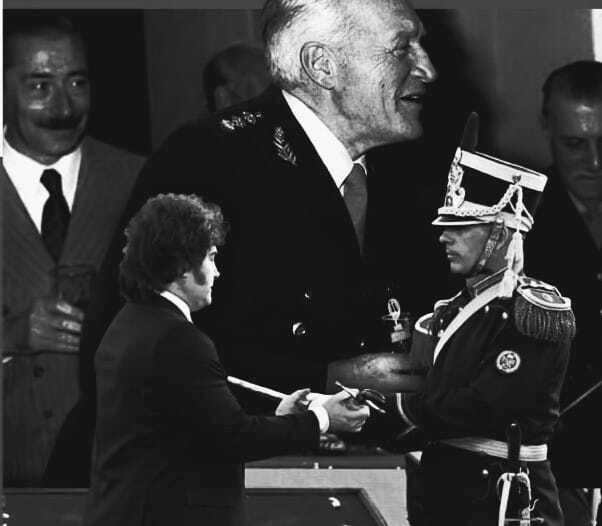
It is my experience, I see it in high schools, when you tell the kids in an interesting way the story or whatever you are going to tell them, they get hooked on the idea of thinking of a society according to the people we love. Because that also has to be put at play, the deepest feelings to make the deep politics of transformation that we need. Del Frade in School 330, 'Republic of Greece' in Granadero Baigorria, sharing a talk 50 years after the coup. You say that journalistic research must have three passions as pillars: love, power, and death. Do you say that people choose to believe before seeing and thinking… What one must not lose sight of is that both the major media of communication and the data-ism that arrives through the cell phone are tools of the great companies of capitalism, which means, among other things, to consolidate a collective consciousness oriented to think that solutions are individual and based on consumption, an exacerbated consumerism and individualism. There it was clear that the workers and the students were going to be in the eye of the storm of the next coup d'état and that is what happened. And besides, the victory of March 16, '74, what is known as the Villazo marked the unity with the working sectors of all sectors, even the middle sectors of all of Villa society, that's why it started there. Oriented by the questions of journalistic research, those that should serve us, as you say, to guide us in life, how much do we know about the how? These are the ones who are also behind the government of Milei and in direct relation with the government of the United States. In the photo: Ramón Genaro Díaz Bessone. Questions that force us to think of a past manifest in the present but in an open future of collective dreams yet to be realized: to recover our own thought, the 'sovereignty of the head,' to build the idea of a 'democratization of happiness' for a society according to the people we love. Can you tell me in some story of the many you heard how these passions can be expressed? In this sense, it is important to take this into account as the origin of what it means today to leave aside memory, political commitment, to risk for collective issues. Those individual insistences but based on the existential commitment with the others are stories that transcend time and mark us that human life has sense insofar as it is in direct relation with the others, the others. Invitation Carlos del Frade will be presenting his new book: 'Fifty years later, from Videla and Galtieri to Milei,' tomorrow March 25 at 7:30 PM at the Commercial Employees Association, Corrientes 450, Rosario, and on March 26 he will be in the city of Santa Fe at 7:30 PM at FESTRAM, Governor Freyre Avenue 1635. They are not answered in a univocal way when one tries the task of investigating, recovering, thinking, and rethinking history.
Later some organizations radicalized by taking up arms, they were no more than 3,000 in all of Argentina and we are talking about 30,000 disappeared. It was an existential policy, to think of life in a key of the whole and not the individual, that is what generated terror in the economic power and from there the state terrorism. If we talk about the when and where, it is necessary to think that the plan of the coup had its antechamber, its 'laboratory' in Villa Constitución, why? For us clearly the matrix of the coup is announced in the invasion of Villa Constitución on March 20, 1975, when, in addition to the order of Alberto Luis Rocamora, Minister of the Interior of the government of María Estela Martínez de Perón, joins the investment of the plant managers of Acindar, Metcon, of Marathon, and of Vilber to kidnap 200 factory delegates who were the base of the Brown List that had triumphed in the internal elections of the Metallurgical Workers Union (UOM) in 1974. 'To defend the company and private property against aggressors of any kind is the first duty,' he expressed at the Rosario Stock Exchange in October 1977, meeting with businessmen. The answer to those who orient us for the next question: why? Those who orchestrated and executed the coup are the ones who also contracted a lot of private debt and then nationalized it with Domingo Cavallo, as president of the Central Bank, in 1982, after Malvinas. Acindar, Celulosa Argentina, PASA (Petroquímica Argentina S.A.), Las Marías, Ford. Who orchestrated and executed the coup? They are boys and girls in all places of the province, in big cities and small towns. That is an enormous amount of people who are resisting with values of solidarity, collective values, shared history. There is a hope there and the first thing to do with it is to make it visible, so that it is seen that we are many who want a more humane society and not this beligerant anti-humanism as the French philosopher Éric Sadin would say. That decision of the companies to invest to disappear was effectively the matrix, it happened in Villa Constitución and that for us is very important. One has to think about recovering our own thought to try to build the idea of a democracy of happiness. There was a systematic plan of annihilation of the youth student and worker, that one that proposed a radical change for an egalitarian society. Can you tell us about your experience with the youth that you continue to bet on? There is no town where I go where there isn't a group of young people that carries forward a popular library, a theater group, a music group, ecological groups, support groups, educational groups. There it was clear that the companies were going to invest at a rate of 200 dollars per day for the repression and disappearance of people. There is also a great hole that one has to repair, especially that great tool of critical thinking that is education. She does everything possible to give birth, has her daughter, has no way to write to her, so with an aspirin, for lack of chalk, she writes on one of the walls of the Devoto jail a beautiful poem for her daughter that later, with the years, ends up being a music teacher and singing at the act for the 20 years of the dictatorship in the Superior of Commerce. 'The businessmen form one of the first sectors that constitute the Nation day by day. Or the testimonies of so many valuable people as when she is kidnapped for teaching to read and write to the mensú of Corrientes they take her prisoner and torture her violently and however when she leaves they tell her she has the possibility to go to France she decides to return to teach them to add, subtract, read and write to the workers. What reflection can you contribute to us at this point. It seems that in the title we talk about what you call 'the puppets' but, who were the puppeteers? A wonder, an extraordinary triumph of love against death and power. There the rights yield their place to the duties. And finally how do we get out of this: you speak of the sovereignty of the head and of beligerant humanism. For this month the provincial deputy and before all, journalist and investigator, Carlos Del Frade, is presenting his new book: 'Fifty years later, from Videla and Galtieri to Milei' and also sharing a seminar of journalistic investigation and political history. Young workers with ideas of equality, of social justice. That has to do with what began to happen from 1979 when José Alfredo Martínez de Hoz took the monopoly of external marketing to the National Grains Board. And going back to the cardinal points forward who are today the puppeteers of the government of La Libertad Avanza? The first thing to say in relation to the question is that the puppeteers from above, as we say them, were the members of the economic power. Ramón Genaro Díaz Bessone who had been Commander of the Second Army Corps and later Minister of Planning of Videla, said it clearly: 'We made the coup to defend capital and private enterprise,' that is to say for the businessmen. It seems to me that the completeness has to do with that and to see the numbers because the victims linked to the security forces and armed forces are minimal compared to the 30,000. The key issue is that here there was state terrorism, those who were behind those who executed the state terrorism are the members of the economic power of then and also of the present. Fifty years of the coup but between them 43 years of democracy, what happened in all these years that lead us to Milei. You say that 'what they could not do with boots, they did with votes. All the big companies, the group of those who foreignized and concentrated the riches and also the banks that began to set the policies with what was the financialization of the economy. Today those sectors are the ones that win the most in Argentina: mining, banks and the agro. And here we think in the who-es. This marks what was the objective of the dictatorship and how those sectors that had united in the street fight especially in the years of the 'azos' of '69, marked in some way the genesis of the coup. How much history do we lack to reconstruct, when will we reach that which is named as… the 'complete' history. In reality, the complete history will be when the bodies of all and each one of the disappeared persons appear and when all and each one of the babies kidnapped and born in captivity and raised in appropriator families appear. That is why the moral responsibility is the other great vertice of this eminent social function, and it begins inside the same company. As Carlos del Frade develops to approach those questions it must be taken into account that they are situated in different cardinal points. Cover photo of the new book of Carlos del Frade: 'Fifty years later, from Videla and Galtieri to Milei.' There are those who say today that youth is 'lost.' The triple 6 is that: 6 out of 10 disappeared were workers; 6 out of 10 were between 15 and 35 years old and today 6 out of 10 young people between 18 and 24 work in the informal economy. And besides that they were between 15 and 35 years old. Interview to Carlos Del Frade to contagion a 'beligerant humanism' and to fall in love again with the word 'revolution'. Editorial Fundación Ross. Today is fulfilled half a century of the last military, patronal and ecclesiastical coup d'état and the date and the context forces us to rethink. One of the architects of the machinery of torture.